
BTO Group Reno Company Profile
Quality Standards
Superior Craftsmanship
Beyond the surface, it’s the precision that lasts. Explore the industrial-grade methods and high-performance materials our workshop uses to ensure your home stays perfect for decades in Singapore’s humid climate.
The Invisible Shield for Your Kitchen
Standard cabinets in Singapore often use EVA hot-melt glue. Over time, those visible glue lines darken, absorb humidity, and cause the edges to swell—a common sight in HDB kitchens.
Marine-Grade Waterproofing
PUR creates a permanent chemical bond that moisture cannot penetrate, making it the ultimate solution for sink areas and wet zones.
Heat & Peel Resistance
Unlike standard adhesives that soften near hobs and ovens, PUR withstands high temperatures, ensuring your edges never peel off.
Our Factory Standard
We apply PUR seamless edging on every single panel—ensuring a cleaner finish, superior durability, and a much longer service life.
PUR vs EVA Comparison
Invisible seams · Waterproof seal · Zero darkening
Standard EVA: Thick visible seams, prone to moisture swelling.
Premium PUR: Tighter, cleaner seal that stays waterproof.
The Precision Advantage
Manual on-site drilling is where long-term alignment issues begin. When hinge and shelf holes are inconsistent, cabinet doors sag and hardware wears out prematurely.
- Zero-Error Alignment: All hinge and slide positions are digitally coordinated for a flawless, gap-free fit.
- Rock-Solid Stability: Panels fit together with tighter tolerances, ensuring your carpentry stays sturdy for decades.
- Factory-Ready Install: All parts are pre-drilled at our factory, leading to a faster, cleaner, and quieter installation at your home.
Manual Drill: Uneven door gaps and inconsistent hardware fit.
CNC Accuracy: Perfect 0.1mm alignment for smooth operation.
Engineered for the Wettest Cabinet in the House
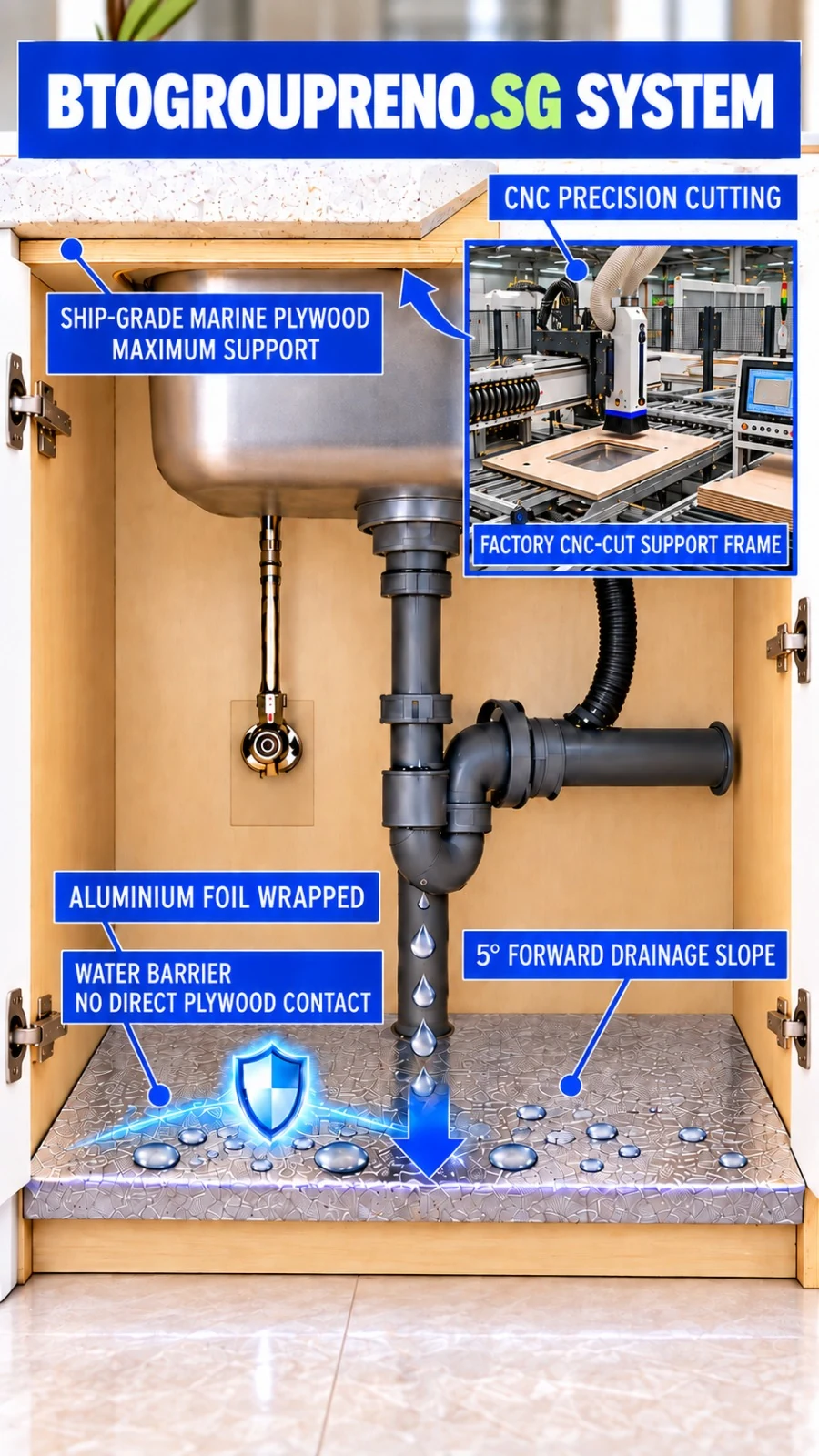
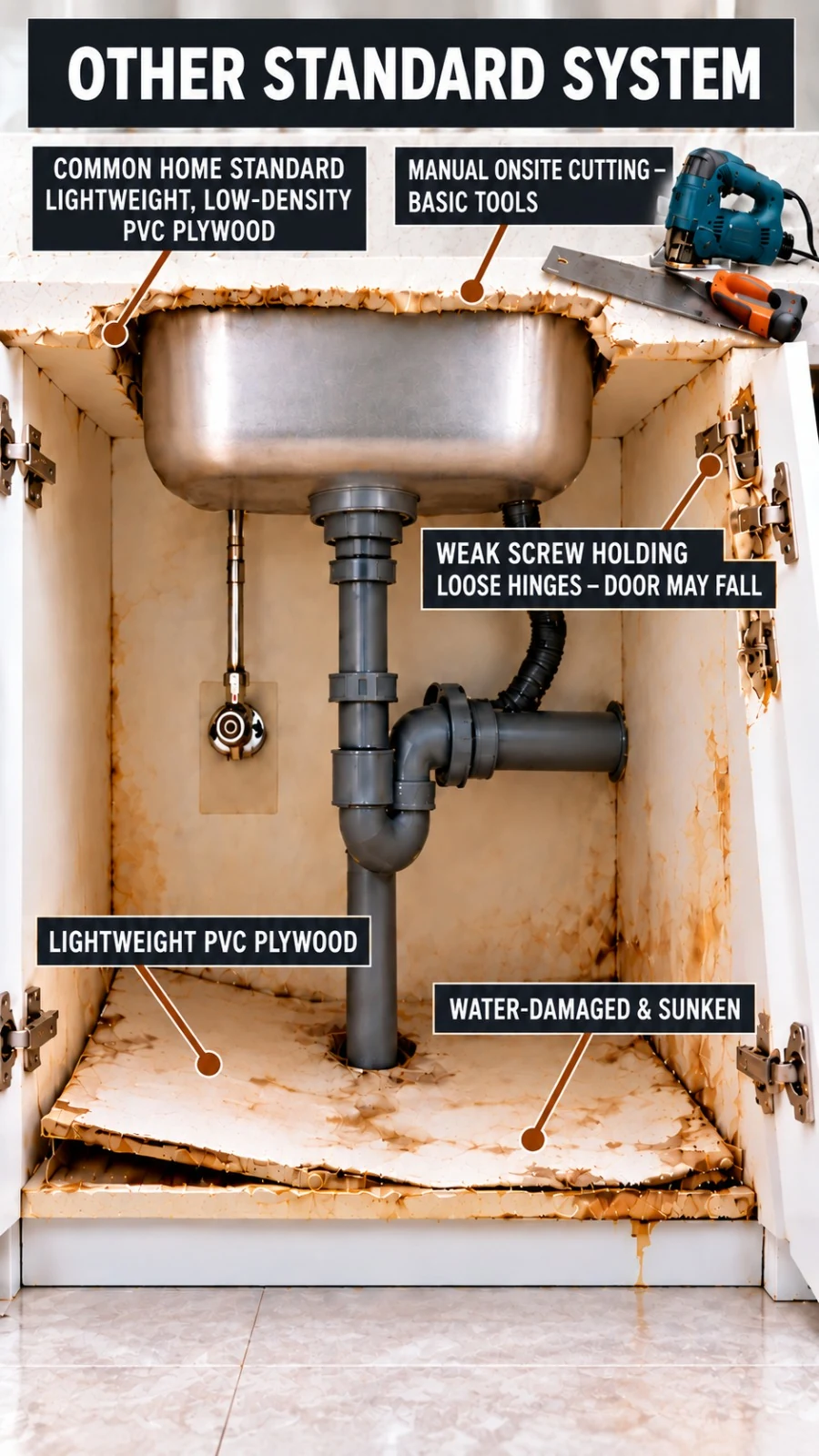
Under the sink is the harshest spot in a Singapore kitchen: constant humidity, the occasional drip from a trap or hose, and a base that never gets a chance to dry out. It is where standard cabinets swell, sag and give way — usually around year three, long after the renovation has been paid for.
01
Ship-grade marine plywood
A dense, water-resistant core built for maximum support — not the lightweight, low-density PVC plywood used as a home-standard shortcut.
02
Factory CNC-cut support frame
The sink opening and its frame are cut to the exact basin model in our factory, so the weight is carried by the frame instead of by screws in a thin panel.
03
Aluminium foil wrapped base
A continuous water barrier means no direct contact between water and plywood. This one detail decides whether the base survives.
04
5° forward drainage slope
Water that does get in runs forward and out, rather than pooling in the back corners where you never see it.
Our Factory Standard
Every sink cabinet we build leaves the factory with all four details in place. It is not an upgrade option — it is the only way we make them.
Without these details
Lightweight PVC plywood, cut by hand on site, with the basin hanging off screws in a thin panel — the base sinks and the plywood soaks.
The BTOGroupReno build
Marine plywood, a CNC-cut support frame carrying the load, a foil water barrier and a 5° slope that sends spills forward and out.
The Edge You Never Look At Is the One That Lets Water In
PUR is the better adhesive, and it is only one of three variables. The other two decide just as much: who runs the machine, and how many edges of a panel the banding actually reaches. Both are settled before the cabinet leaves the factory, and neither can be added afterwards.
01
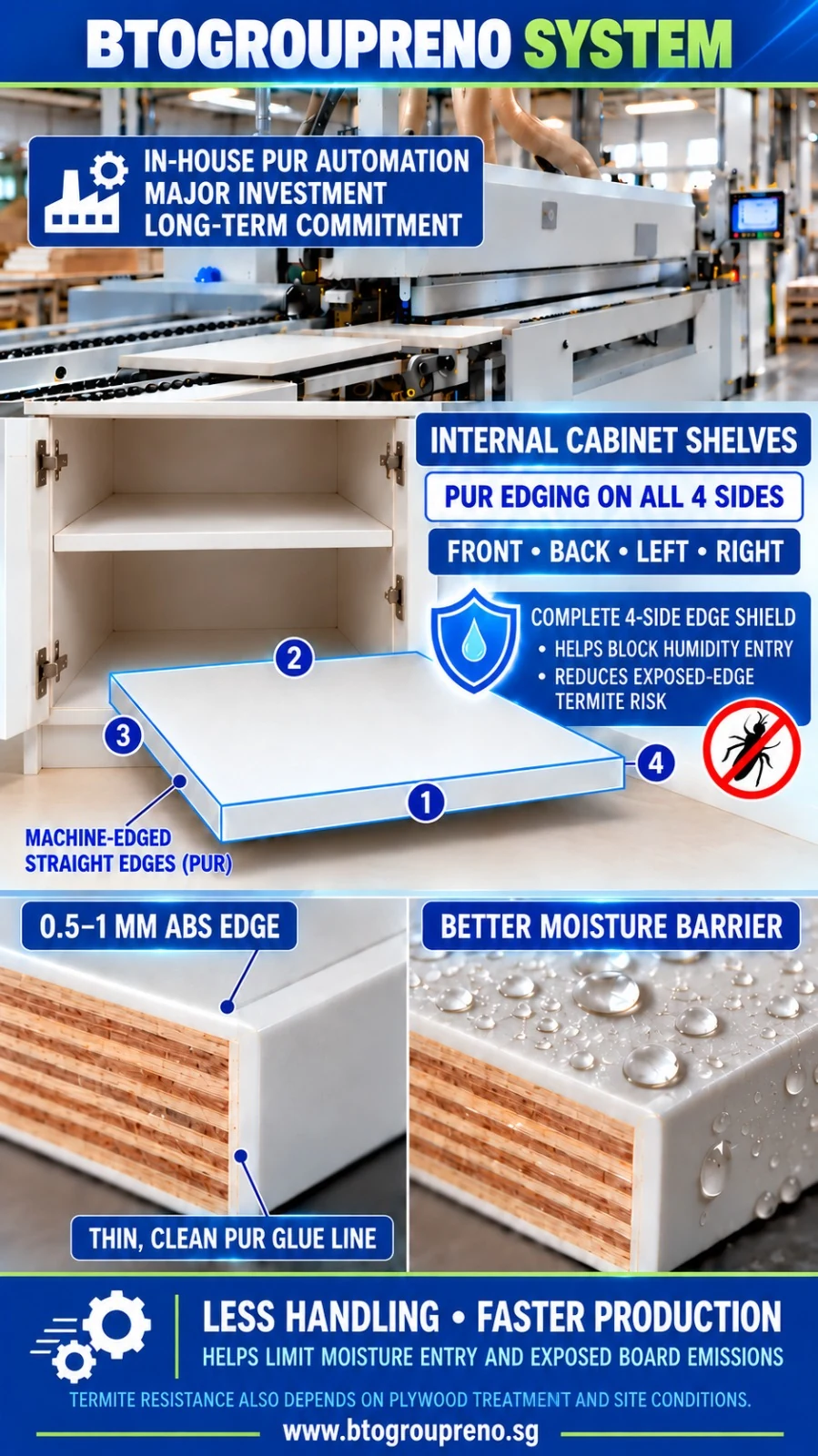
Edged on all four sides
Front, back, left and right on our internal plywood shelves, wherever the machine can process them — not a single strip along the visible front edge.
02
0.5 mm ABS minimum
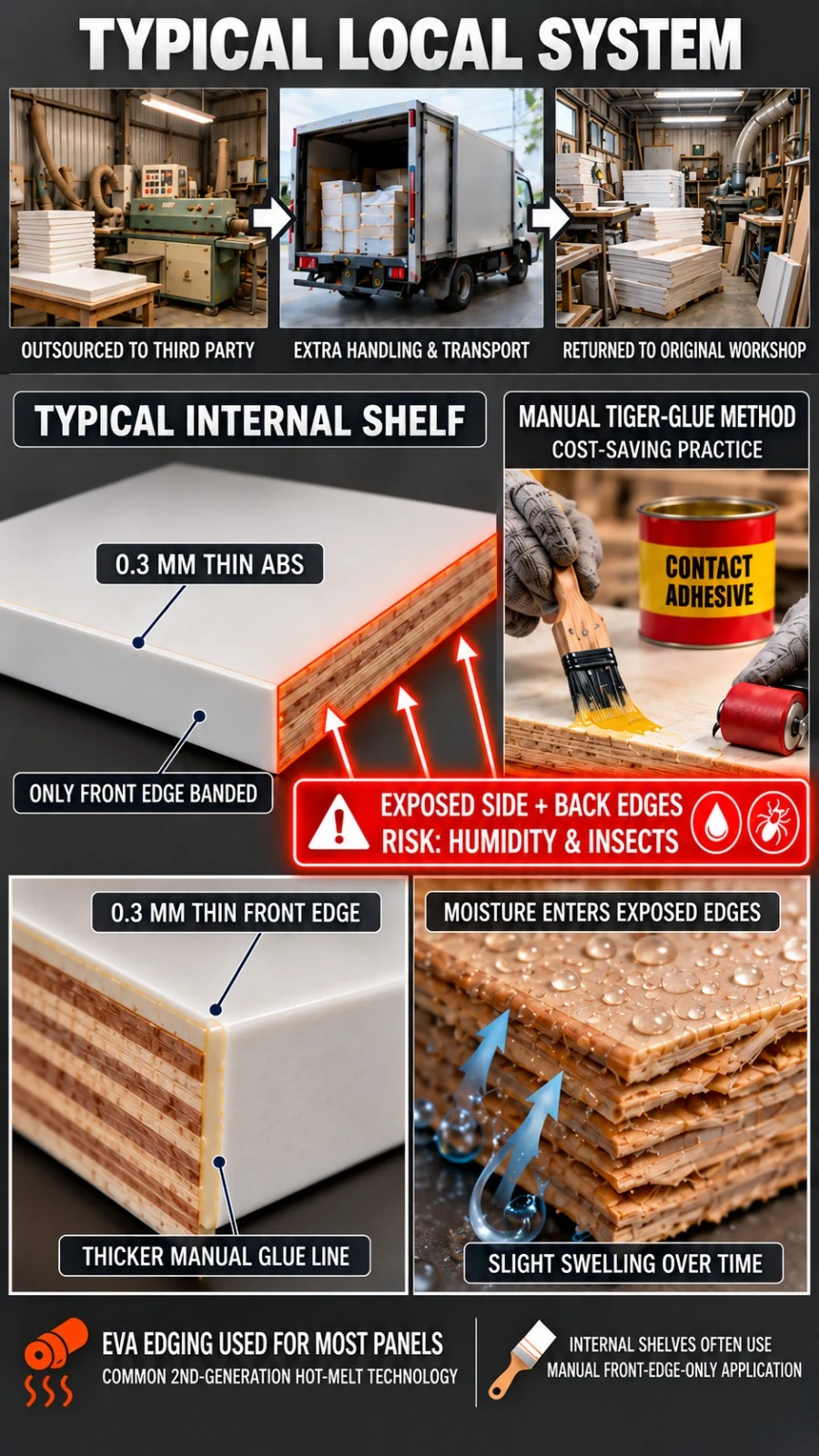
Thicker where the job calls for it. A 0.3 mm band is the common cost-saving choice and leaves far less material between humidity and the plywood core.
03
PUR applied in our own factory
The team that cut the panel sets and checks the adhesive, the edge pressure, the trimming and the finish. Nobody else in the chain gets to decide it.
04
Fewer journeys, less handling
Panels are not trucked to a second workshop for edging and back again. Less handling means fewer scratched surfaces and fewer coordination delays.
What This Does Not Claim
Edge banding does not make plywood waterproof or termite-proof. Board grade, installation and ordinary care still matter. What it does is seal the most vulnerable part of a panel. The full reasoning is in our guide to PUR edge banding.
The outsourced route
Panels leave for a third-party edging shop and come back. More handling, more transport, and the workshop that fitted your kitchen did not control how the edges were sealed.
Our own line
Cut, edged and checked under one roof by one team, with ABS on all four sides of an internal shelf rather than the one edge you would ever see.
