
Why PUR Edge Banding Makes a Better Cabinet for Singapore Homes
PUR is the better adhesive, but it is one of three variables. The other two are whether the edging is done in-house and whether it reaches all four edges of an internal shelf or only the one you can see.
When homeowners compare kitchen cabinets, wardrobes and internal shelving, the conversation is almost always about design, laminate colour and storage layout. One of the differences that decides how the cabinet ages is somewhere nobody looks: the four cut edges of every panel.
PUR edge banding in Singapore is the part of that story most people have heard of. What gets less attention is who applies it and how many edges it reaches. This article is about those two, because they are where the same adhesive produces very different cabinets.
Why cabinet edge banding matters
A panel is raw plywood the moment it is cut. Those edges have to be sealed with an ABS edge band to protect the core and give a finished surface. Poorly applied edging can leave a visible glue line, a weak bond, or sections where humidity has a way into the panel. None of it is obvious at handover. It shows up later as peeling, swelling and a cabinet that has aged faster than the flat it is in.
That matters more here than in a temperate climate. An HDB kitchen in Singapore runs through humidity, cooking heat and the occasional spill every day of the year. We wrote separately about matching board grade to the zone it sits in and about why the cabinet under the sink fails before any other; edge sealing is the third variable in the same equation.
PUR edging versus conventional EVA glue
Many carpentry workshops use EVA hot-melt glue for machine edging. Smaller workshops sometimes attach thin ABS edging by hand, with contact adhesive and a roller. Both can look perfectly acceptable on handover day, but the glue line tends to be more visible, and the result depends heavily on machine settings, materials and the person doing it.
PUR — polyurethane reactive adhesive — cures by reacting with ambient moisture into a bond that cannot be melted back. Processed correctly it gives better resistance to heat and moisture than conventional EVA, with a very thin, clean glue line. The chemistry is covered in more depth as item 01 on our Craftsmanship tab.
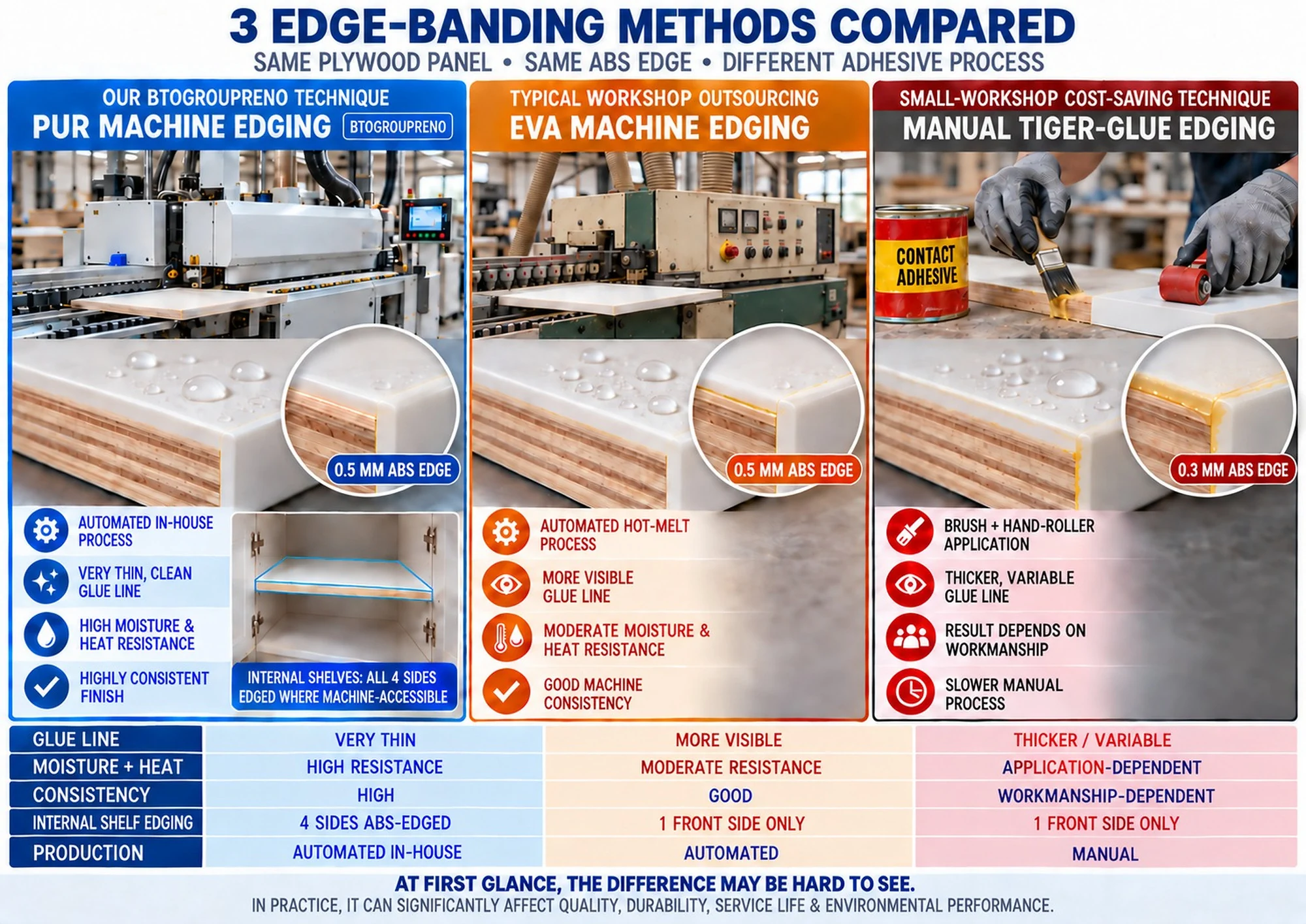
The table below is the same comparison in text, because a table inside a picture is not readable on a phone.
| Glue line | Moisture and heat | Finish consistency | In practice | |
|---|---|---|---|---|
| PUR machine edging | ✓ Consistent | ✓ Consistent | ✓ Consistent | 0.5 mm ABS as our minimum, thicker where needed. Internal shelves edged on all four sides wherever the machine can reach. |
| EVA machine edging | – Varies with settings | – Varies with settings | ✓ Consistent | Automated and consistent, but a more visible glue line and moderate resistance. Internal shelves are commonly edged on the front only. |
| Manual contact-adhesive edging | ✗ Depends on workmanship | ✗ Depends on workmanship | ✗ Depends on workmanship | Brush and hand roller, often with 0.3 mm ABS. Slower, and the glue line varies with whoever applies it. Front edge only. |
✓ Consistent – Varies with settings ✗ Depends on workmanship
At first glance the difference is hard to seeAll three can look clean on handover day. The gap opens up over years of humidity, cooking heat and cleaning, which is exactly when it is expensive to do anything about.
In-house automated PUR edge banding
PUR is not simply a better glue you can drop into any workshop. It needs suitable machinery, controlled settings, trained operators and a standing commitment to keeping the line running, because the adhesive cures on contact with moisture in the air and an idle machine is a problem, not a pause.
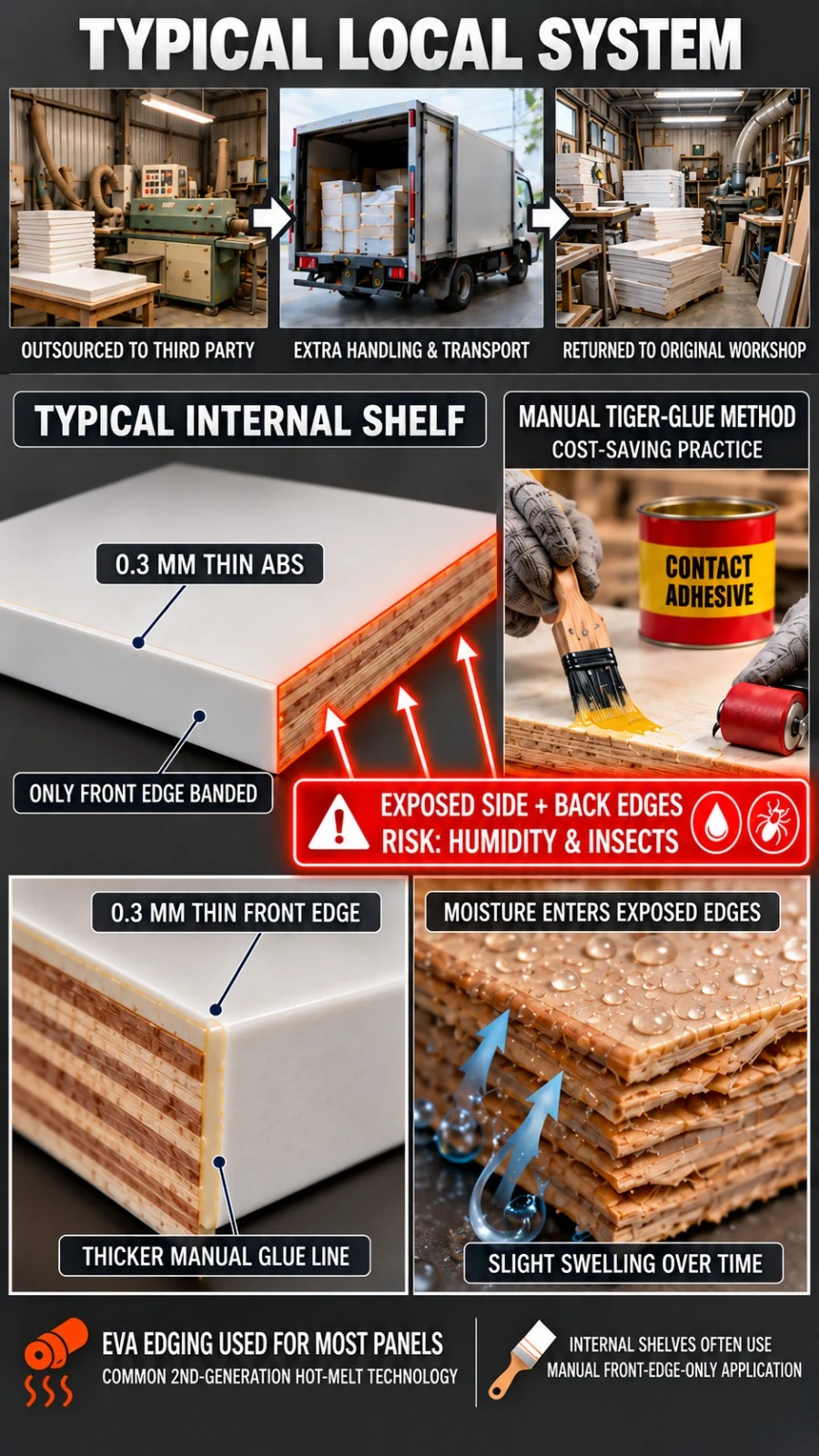
That cost is why the common arrangement is to send panels out to a third party for edging and have them trucked back. It works. It also means every panel is handled more times, travels twice, and comes back to a workshop that did not control how it was done.
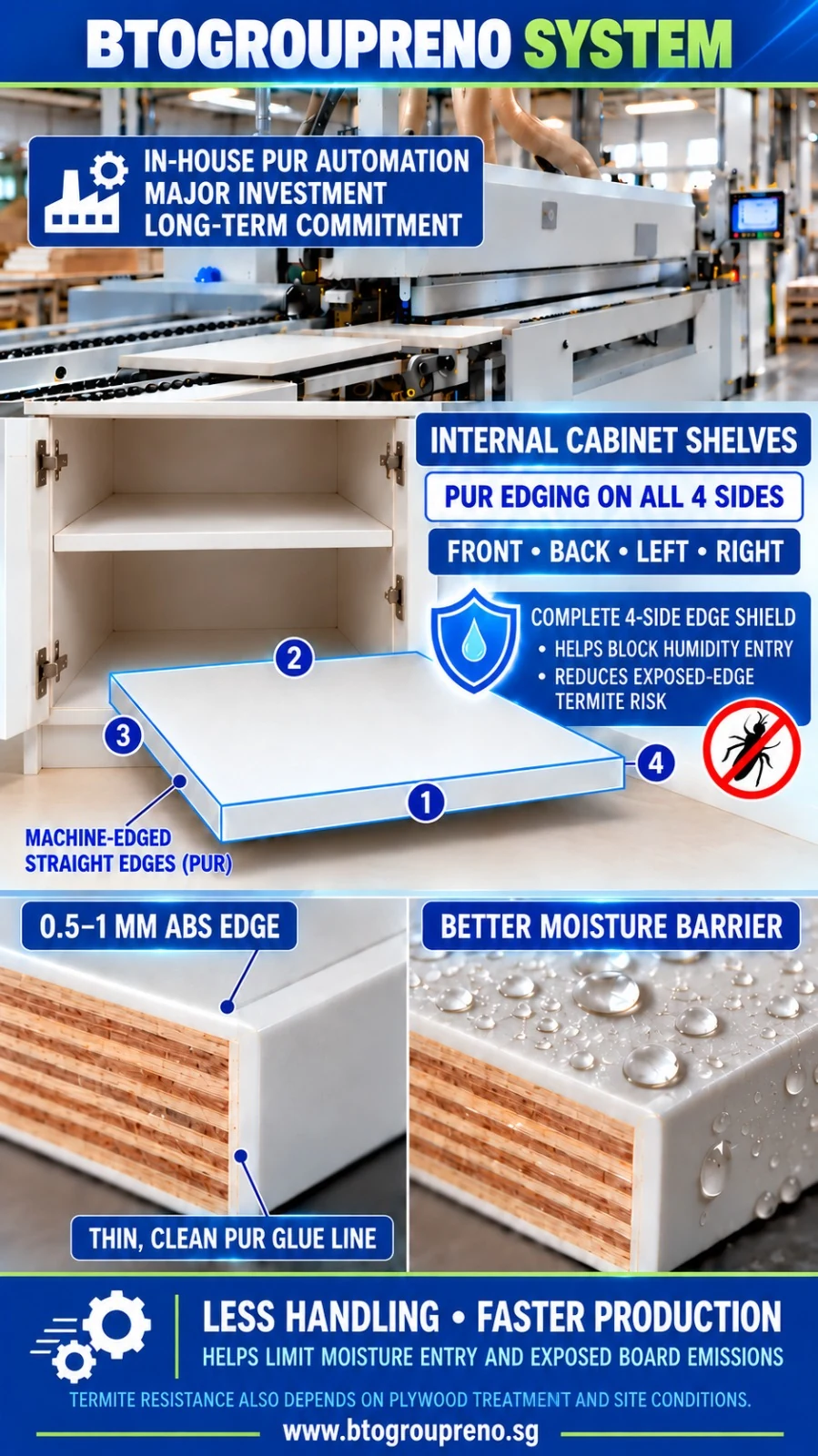
One team owns the resultAdhesive application, edge pressure, trimming and finishing are all set and checked by the same production team that cut the panel.
In-house
Fewer journeys, less handlingPanels are not trucked to a second workshop and back. Less handling means fewer scratched surfaces, fewer coordination delays and fewer chances for a panel to go missing in a queue.
Logistics
It is a fixed cost, not a per-job oneThe machine has to be bought, housed, maintained and kept busy. That is the reason this is not universal, and the reason it is worth asking any contractor who does their own edging.
Why it is rare
Four-sided protection for internal shelves
This is the detail we would point at first, because it costs a homeowner nothing to check and it is almost never specified.
An internal cabinet shelf is usually edged along the visible front only. The side and back edges stay raw. It is a reasonable saving on a part nobody sees once the shelf is in — and it leaves three of the four edges of a plywood panel exposed inside a cabinet that lives in a humid kitchen.
On our internal plywood shelves we apply ABS edging to the front, back, left and right wherever the machine can process them, with 0.5 mm ABS as the minimum and thicker where the job calls for it.
What it does
Edged on four sides
- A continuous band around the whole shelf, not a strip on one side
- Helps block humidity reaching the plywood core at the cut edges
- Reduces exposed-edge access for insects
- Looks finished from every angle, including the back of a glass-front unit
What is left open
Front edge only
- Three raw plywood edges per shelf, facing into the carcass
- The back edge sits against the wall panel, the dampest part of the cabinet
- Invisible after installation, so nobody ever checks it
- Cannot be added later without removing the shelf
How to check it on any quotationAsk one question: are internal shelves edged on all four sides, or the front only? It is a yes or no, it is verifiable at installation, and the answer tells you how the rest of the cabinet is being built.
There is a fuller list of lines worth putting into a carpentry quotation in our wet-zone specification guide.
What better edge sealing does, and what it does not
PUR edge banding does not make wood waterproof and it does not make it termite-proof. Board selection, installation and ordinary household care all still matter, and so does the emission grade of the board itself, which is a separate question from how its edges are sealed.
What better edge sealing does is strengthen one of the most vulnerable parts of a cabinet. A cabinet that lasts longer is also one that does not need replacing early, which is the least glamorous and most real part of a sustainable renovation.
The honest summaryAt first glance the difference between these three methods is hard to see. Over the service life of a kitchen it affects finish, durability and how long the carpentry stays worth keeping.
Come and look at the samples
Everything above is checkable in about ten minutes, in person, with three offcuts side by side. Run a fingernail along a PUR edge, an EVA edge and a hand-glued one; look at the glue line under the light; pull out an internal shelf and look at its back edge.
Our workshop is open for exactly this. What else is worth looking at while you are there is in the eight things to check on a carpentry factory floor, and the current factory open house page has the session details. The kitchen system page covers the worktop, kerb and sink base that sit around this carpentry.
Frequently asked questions
Is PUR edge banding worth paying more for?
For wet and warm zones — kitchen runs, bathroom vanities, the service yard — the better heat and moisture resistance is doing real work. For a bedroom wardrobe the difference is mostly the thinner glue line, which is an appearance benefit rather than a durability one. That is the honest split.
How can I tell whether my cabinets were edged with PUR or EVA?
Look at the glue line where the edge band meets the panel, under a direct light. PUR leaves a very thin, clean line. EVA leaves a more visible one, and hand-applied edging leaves a thicker line that varies along its length. If you can feel a lip with a fingernail, the edge was not machine-pressed flush.
Does four-sided shelf edging really matter if nobody sees three of the edges?
It is not about appearance, and in a compact HDB kitchen it matters more, not less, because the cabinets sit tighter against walls with less air moving behind them. A raw plywood edge is where humidity reaches the core, and the back edge of a shelf sits in the least ventilated part of the cabinet. It is also the one thing on this page that cannot be added afterwards without taking the shelf out.
Can edge banding be repaired if it lifts?
A short lifted section can sometimes be re-bonded. A band that is lifting along its length is usually telling you the bond was weak or the core has taken on moisture, and re-gluing the surface does not address either. Raise it inside the defects liability period rather than after.
The short version
PUR is the better adhesive, but the adhesive is only one of three variables. The other two are whether the edging is done in-house under your contractor’s own control, and whether it reaches all four edges of an internal shelf or only the one you can see. Both are checkable before you sign, and neither can be added once the panel is built.
