
E0, E1 and ENF: What Formaldehyde Emission Grades Mean for HDB Cabinetry
E1, E0 and ENF are the emission grades you will see quoted for HDB carpentry board. Here is what each one actually means for your flat's air quality, and what to ask your contractor.
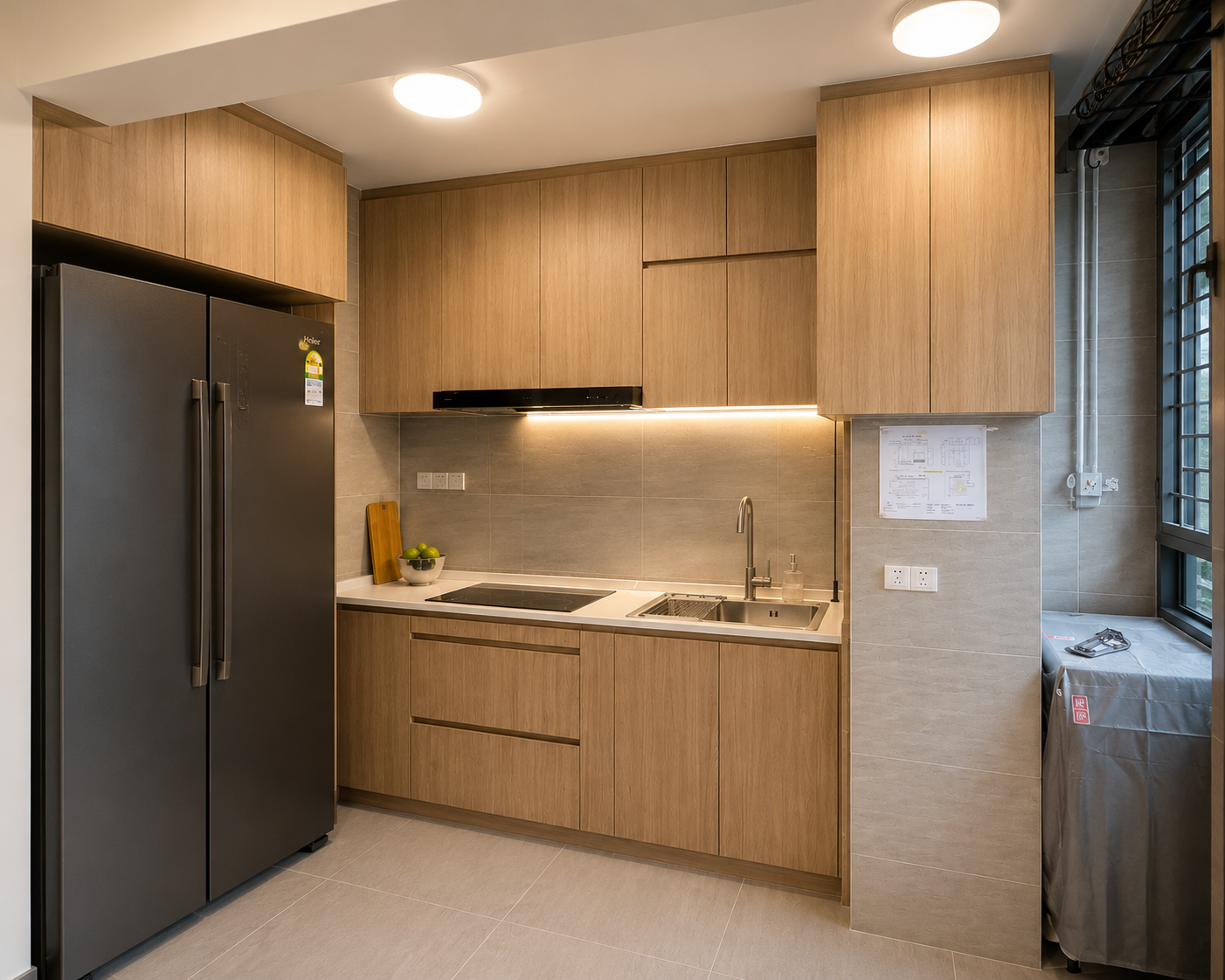
A new BTO flat means new built-in carpentry throughout the home: kitchen cabinets, wardrobes, the TV console, a shoe cabinet, and, in many homes, a bathroom vanity. Nearly all of it is built from engineered wood panels, and that board is bonded with resin-based adhesives that can release formaldehyde into the indoor air. If you have young children or anyone in the household who is particularly sensitive, the emission grade of that board matters.
E1, E0 and ENF are the grades most commonly quoted. This guide explains what each one means for an HDB home, in plain English, how they compare, where each makes sense in a flat, and exactly what to ask before you approve your carpentry specification. Every kitchen, wardrobe and vanity pictured here is a real HDB home we designed and installed — you can see more in our portfolio of completed homes.
Why new BTO carpentry releases formaldehyde
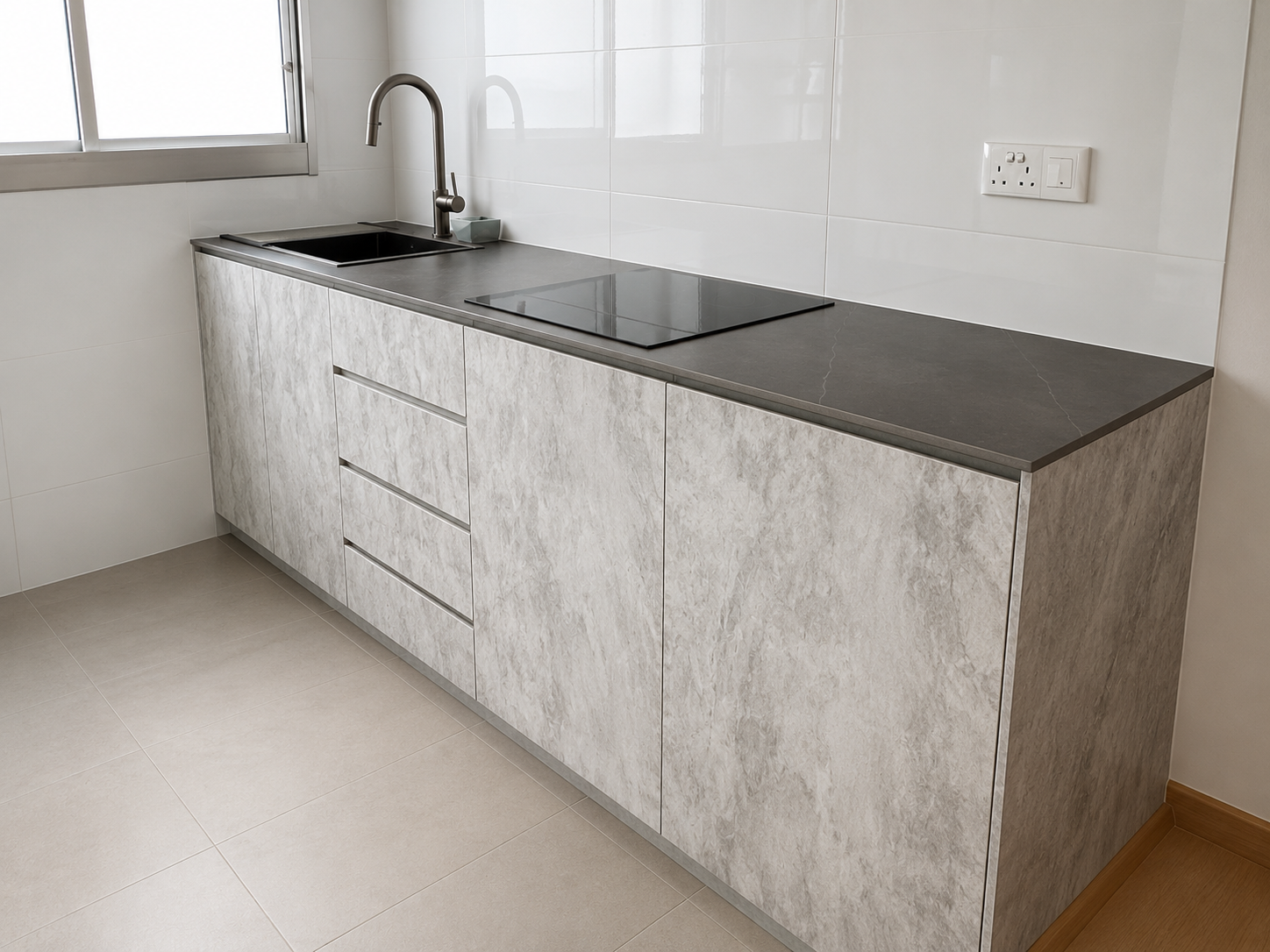
Take the 189A Marsiling kitchen above. Almost every surface you can see — the carcasses, the doors, the shelves — is engineered wood panels, and built-in carpentry is almost never solid wood. It is plywood, particleboard (chipboard) or MDF, made by bonding wood fibres or veneers together with resin. That resin, usually a urea-formaldehyde glue, is what slowly releases formaldehyde into the air, especially when everything is brand new and the flat is sealed and air-conditioned.
A full BTO fit-out installs a substantial quantity of newly manufactured board at once, in a fairly small, enclosed space. So the total amount of new carpentry formaldehyde emissions at the same time is exactly why the grade you choose is important to understand.
E1, E0 and ENF — the three grades in plain English
These are emission grades. They cap how much formaldehyde a board is allowed to release. From most common to strictest:
- E1 — the standard baseline. Widely used and meets the basic emission limit. Think of it as “acceptable,” not “low.”
- E0 — a genuine low-emission grade, roughly half of E1’s limit or lower. It represents a meaningful reduction in formaldehyde emissions.
- ENF — the most stringent of the three grades, the lowest formaldehyde-emission limit commonly specified. It sits closest to the trace levels of natural wood.
The exact numbers behind each grade depend on the test standard used, which is why two boards both labelled “E0” are not always identical. We break down the actual figures in our companion guide on E0 versus E1 test numbers.
How the three grades compare at a glance
- Emission level: E1 = baseline · E0 = about half of E1 or lower · ENF = the lowest, closest to natural wood.
- Best used for: E1 = general, well-ventilated areas · E0 = bedrooms, children’s rooms, most of the home · ENF = nurseries and households with occupants who are particularly sensitive.
- Cost impact: E1 = standard · E0 = a small premium · ENF = a slightly larger premium, although still modest relative to the total cost of the carpentry.
- How to verify it: ask for the letter grade plus the test standard, in writing, not just an “eco” sticker.
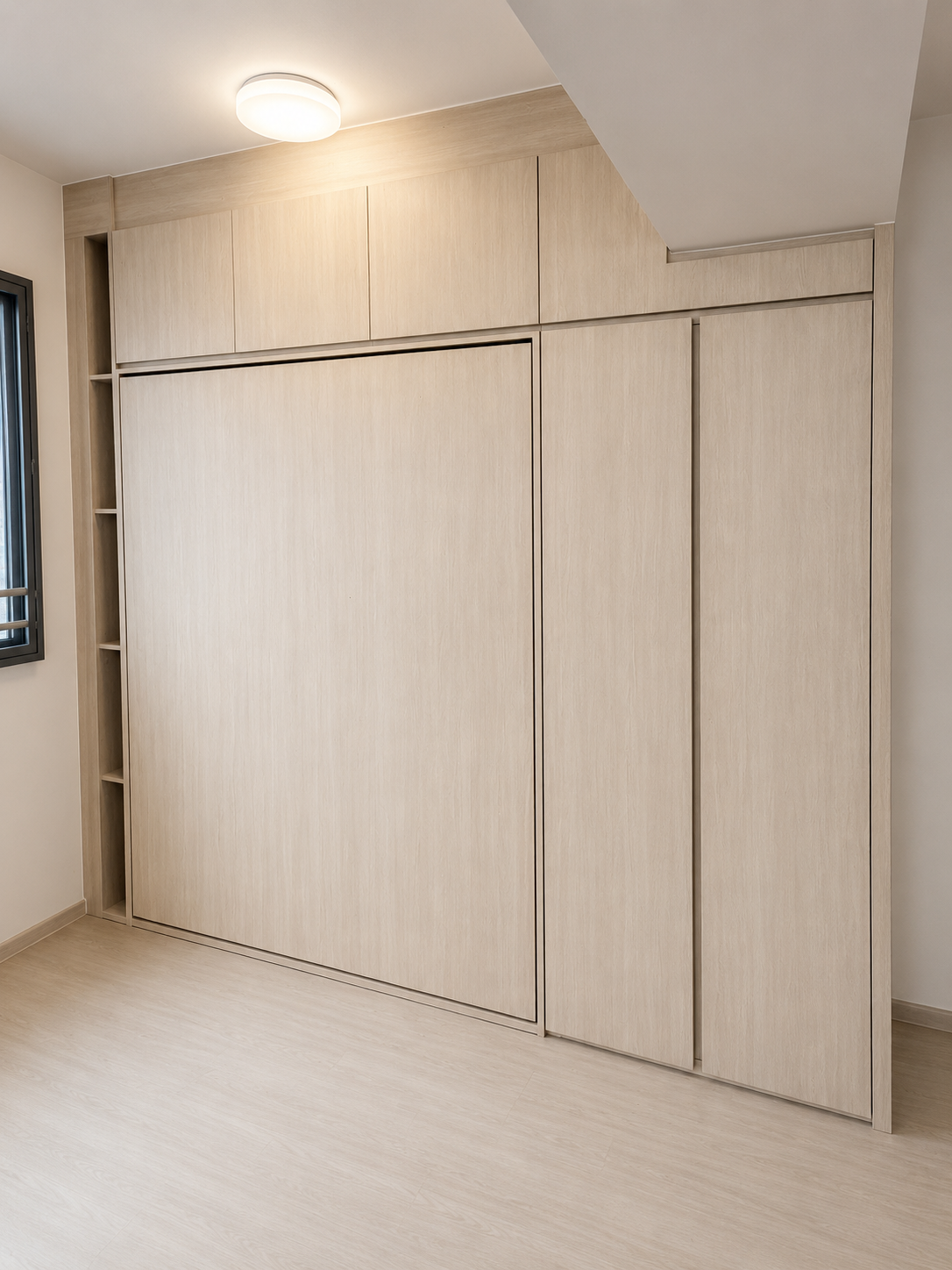
That 371B Sembawang wardrobe is a good example of why the grade matters: it is a large area of engineered wood panels in a room occupied for many hours each day. On a full fit-out like this one, we specify the grade for every piece before we build, which is where the next distinction — a real grade versus a marketing label — comes in.
F-four-star, CARB and “eco board” — cutting through the labels
You may also hear other labels. Roughly, F-four-star (the Japanese JIS mark) is broadly comparable to E0, while CARB Phase 2 and US TSCA Title VI are American emission limits at a similar low level. Different schemes, same basic idea of lower formaldehyde.
What to be wary of is vague marketing. “Eco board” or “green board” with no named grade and no test standard has little meaning without supporting documentation. Always ask for the letter grade and the standard behind it.
Emission grade alone is not enough: ventilation still matters
A grade sets a limit on emissions from the board under specified test conditions, but your flat has a large amount of board installed at once, and new HDB homes are often kept closed and air-conditioned. New carpentry also off-gasses the most in its first few weeks to months.
So treat it as two complementary measures. A better grade (E0 or ENF) lowers the source. Ventilation helps reduce the concentration of pollutants indoors: open the windows, run fans, keep cabinet doors and drawers open, and ventilate the flat thoroughly before a baby or young child moves in. Using both measures provides a more effective approach to indoor air quality.
Where each grade makes the most sense in an HDB flat
- Bedrooms and children’s rooms: this is where you sleep and where the biggest wardrobes sit, so consider specifying E0 or ENF.
- Kitchen: a large amount of cabinetry, but usually better ventilated and primarily occupied during the day, E0 is a sensible default.
- Bathrooms and vanities: here moisture resistance matters as much as emission grade, so specify both.
- TV consoles, shoe and store cabinets: E1 can be acceptable if the area is airy, but matching everything to E0 provides a consistent specification throughout the flat.
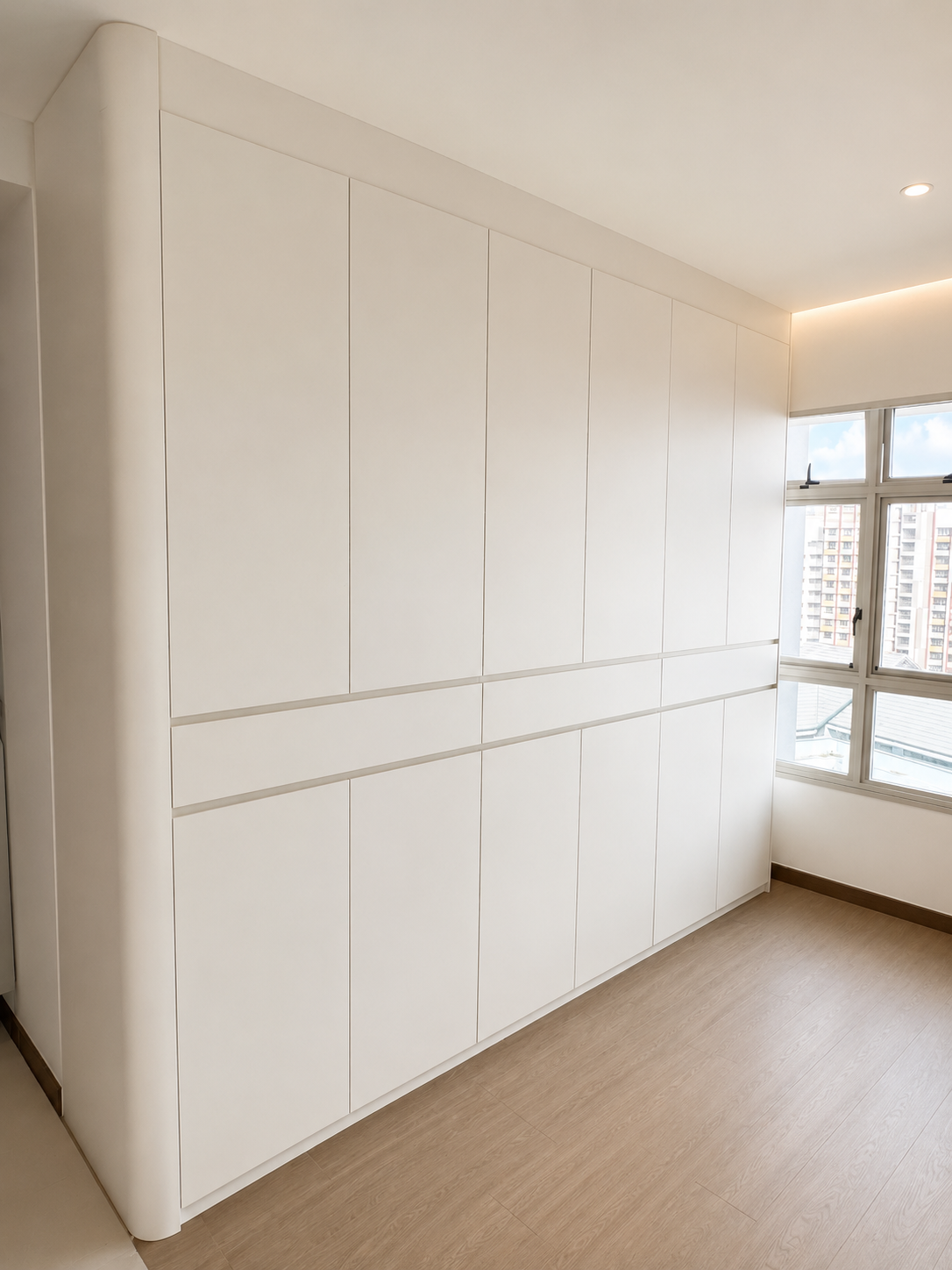
The Bartley Beacon vanity above sits in a bathroom, so here we specify two things at once: a low emission grade for the air and a moisture-resistant board so it does not swell. We cover moisture resistance in our guide on choosing board that survives Singapore’s humidity.
What to ask before you approve your carpentry specification
You do not need to be an expert. Five direct questions will clarify most of the key details:
- What emission grade is the carcass board, E1, E0 or ENF?
- Which standard is that grade tested to?
- Are the doors and laminate the same grade as the carcass?
- Can you show me the grade on the spec sheet or the panel label?
- Can you put that grade in writing on the quotation?
A grade written into your quotation is a commitment. A grade promised verbally on site is not.
The key is to have the agreed specification documented in writing. Our BTO renovation packages state the board grade up front, so you are not left guessing after the deposit is paid.
Frequently asked questions
Is E1 board safe for a home with a baby? E1 meets the baseline emission limit, but for a nursery or a sealed, air-conditioned flat, E0 or ENF board plus good ventilation is the lower-emission option that many homeowners prefer.
Is ENF board significantly more expensive? The board premium is usually modest compared with the total cost of your carpentry. Ask your contractor to price E0 or ENF as an option so you can see the actual difference for your flat.
Can I make new carpentry reduce formaldehyde levels more quickly? Yes. Ventilate the home thoroughly for the first few weeks, keep doors and drawers open, and run fans. Warmth and airflow both speed up how quickly a new fit-out releases and clears formaldehyde.
Does laminate seal the formaldehyde in? Fully laminated and edge-banded faces reduce emission from those surfaces, but cut edges, backs and cabinet interiors still emit, so the underlying board grade still matters.
Renovate together and save
Low-formaldehyde board is more affordable than most homeowners expect, and it costs even less when neighbours renovate together. With BTO Group Reno’s group renovation, homes in the same project share prefabrication and installation, so you can specify E0 or ENF carpentry while keeping the overall budget under control.
Explore more
- See our full portfolio of completed HDB homes
- Companion guide: E0 vs E1 for HDB carpentry — what the test numbers mean
- 5 kitchen design ideas for 2026
- Wardrobes that do more: smart storage ideas from real HDB homes
Ready to start your renovation?
Every kitchen and wardrobe you have seen here was designed, prefabricated in our own local workshop and installed by our own team — backed by 1,000+ HDB projects across Singapore. So the board grade we promise is the board grade you get.
- Book a free showroom visit to see and compare board finishes in person.
- Join a Group Reno for your BTO, or check the upcoming groups.
- Prefer to talk? Contact us or call +65 8852 6257.
Related HDB Carpentry Guide: For more information about selecting materials and planning built-in cabinetry, see our HDB BTO carpentry materials guide.
