
E0 vs E1 for HDB Carpentry: Understanding the Test Figures
E0 and E1 are grades, but the numbers and test methods behind them decide what they actually mean. A plain-English guide for HDB homeowners specifying carpentry.
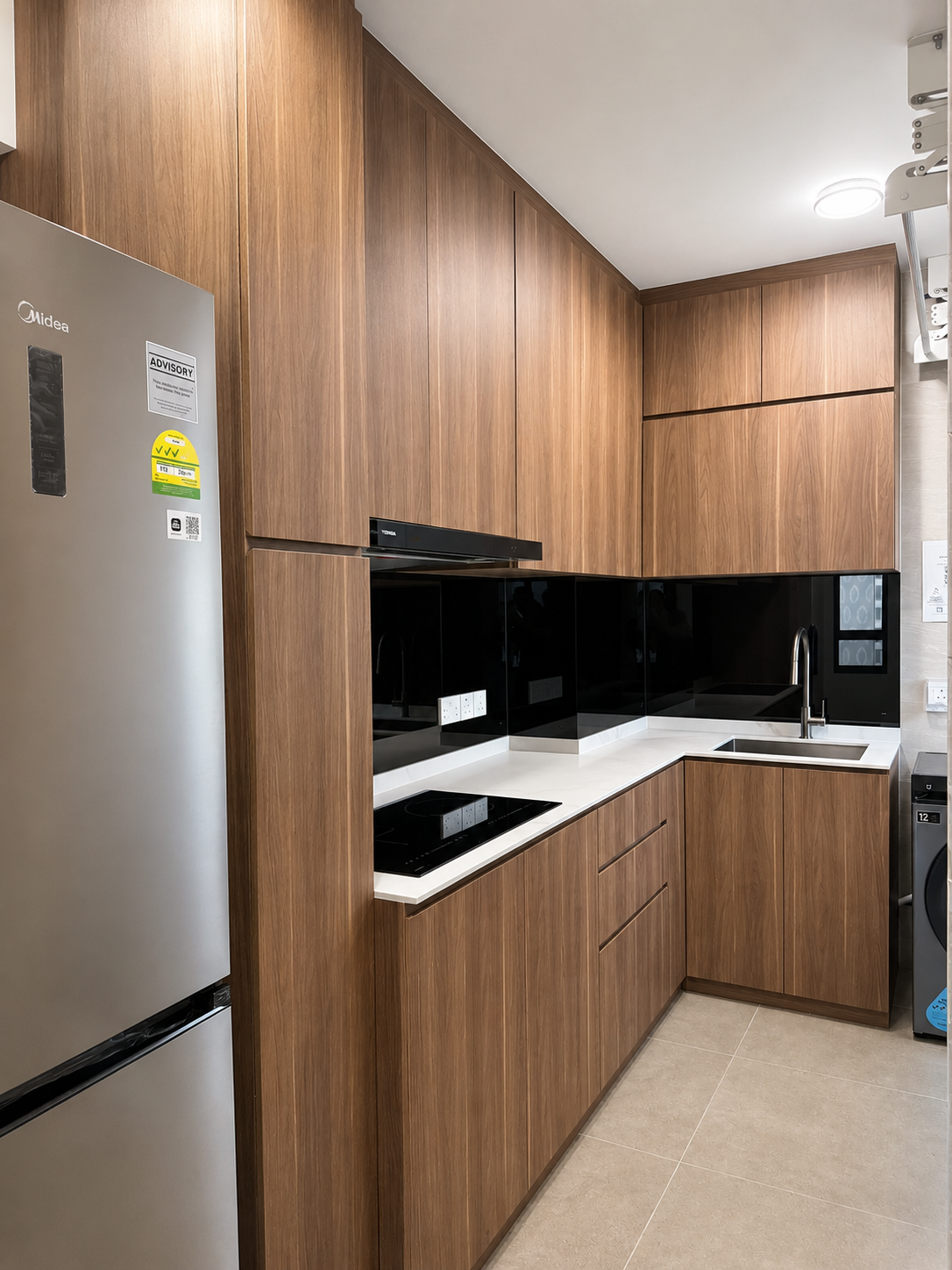
If you have read our guide to E1, E0 and ENF grades, you know E0 is lower-emission than E1. But the grade labels alone do not tell the whole story. Behind each one is a number and a test method, and that is where two quotations, both saying “E0”, can actually mean different things.
You do not need to become a chemist. This guide explains the numbers behind the grades in plain English, so you can tell a solid low-formaldehyde spec from a marketing label. The kitchens and wardrobes shown here are real HDB homes we built — see more in our portfolio of completed homes.
What the grades actually measure
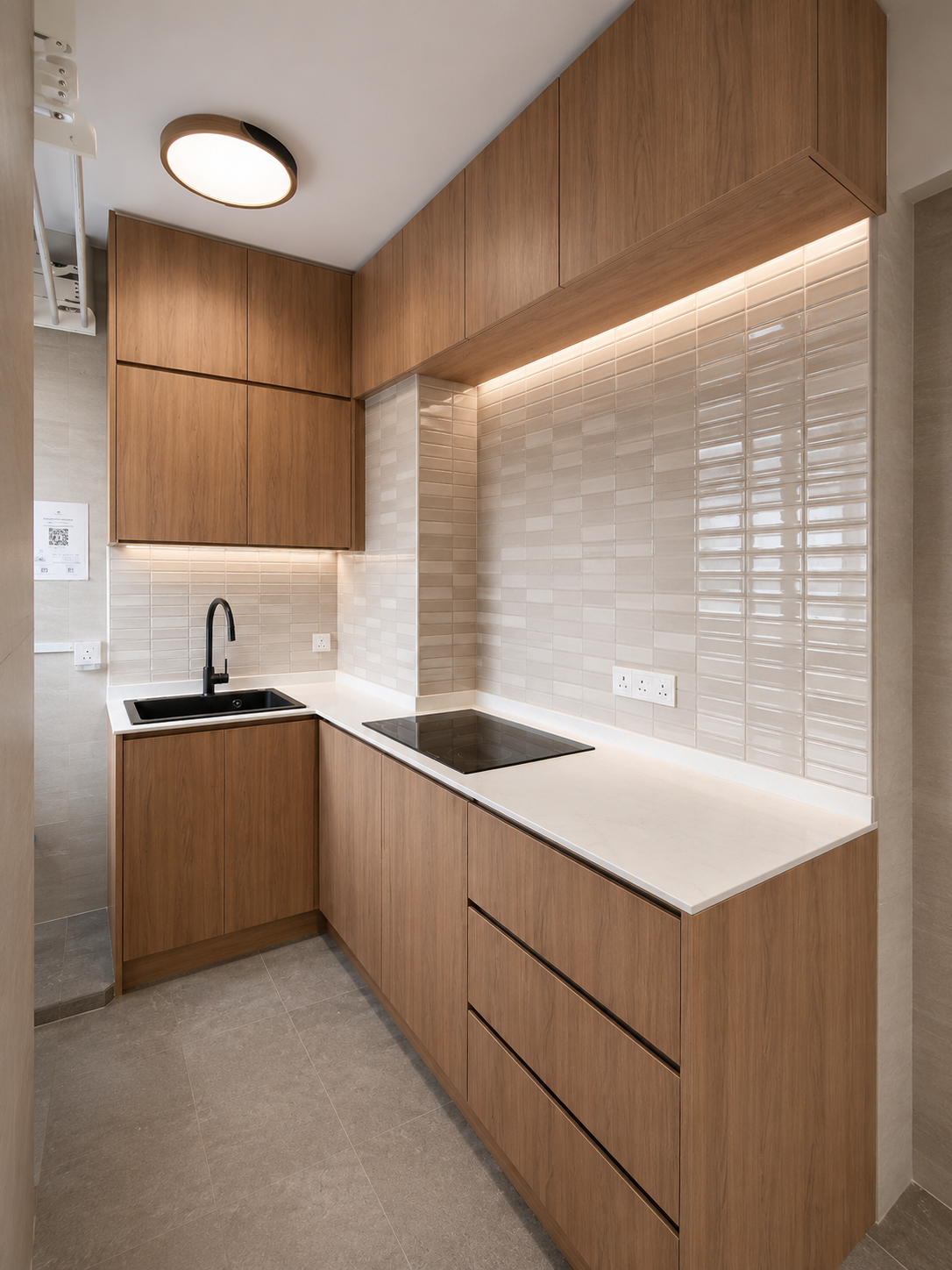
The 300D Tengah kitchen above is exactly the kind of extensive carpentry installation these numbers describe. An emission grade measures how much formaldehyde a board releases into the air, usually as a concentration: milligrams per cubic metre of air (mg/m³) in a controlled test chamber, or sometimes parts per million (ppm). In general, a lower result indicates lower formaldehyde emissions under the stated test conditions.
The board is placed in a sealed chamber under set temperature and humidity, and the air is measured. That measured figure is what the grade is based on.
Indicative emission limits
- E1 — around 0.1 mg/m³ (the commonly cited chamber figure is 0.124 mg/m³). The baseline.
- E0 — roughly 0.05 mg/m³ or lower. About half of E1, often less.
- ENF — around 0.025 mg/m³. The strictest, closest to the trace levels of natural wood.
Treat these as general reference figures. The exact limit depends on the standard behind the grade, which is the next thing to understand.
Why two “E0” boards aren’t always the same
Different countries test formaldehyde differently, and the test method affects how the result is measured and reported. A European EN chamber test, a Japanese JIS desiccator test and a US ASTM method do not all measure in the same way or report the same units, so a board can pass “E0” under one scheme and be quoted slightly differently under another.
This is why the grade alone is not sufficient. The grade plus the named standard is. “E0 to JIS A 5908” tells you far more than “E0” on its own.
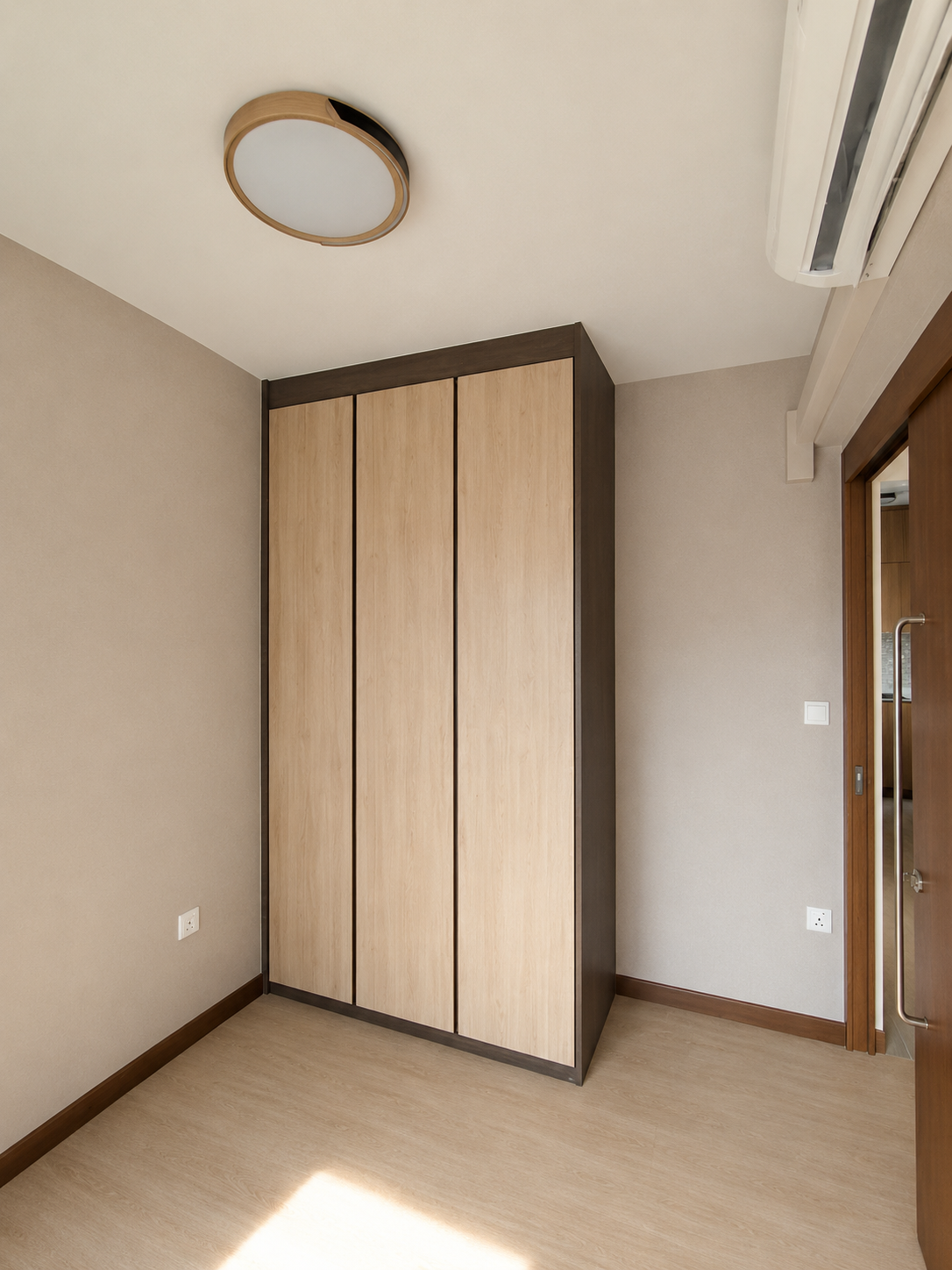
A wardrobe like the 300D Tengah one above is a lot of board in a single room, so the gap between an E1 number and an E0 number really adds up. That is why, before we build, we confirm not just the grade but the standard it is tested to.
ppm or mg/m³ — understanding the units
You may see a grade quoted in ppm (parts per million) instead of mg/m³. They are different units for the same idea, and there is a rough conversion, but homeowners generally do not need to perform the conversion themselves. If a number looks unusually low or high, ask which unit and which standard it refers to.
What the number means for your flat’s air
A chamber figure is measured for one board in controlled conditions. Your flat has a substantial amount of engineered wood installed at once, often in a sealed, air-conditioned space, so the cumulative effect in a real room can be higher than any single test number suggests. Choosing a lower-number grade, and ventilating well when everything is new, both help.
A test report provides stronger evidence than a printed label
A grade can easily be printed “E0” on a specification sheet. A manufacturer’s test report, tied to a named standard and a product, is more reliable evidence. For a substantial carpentry project, it is reasonable to ask your contractor to show the board’s grade on the manufacturer’s documentation, not just in the quotation text.
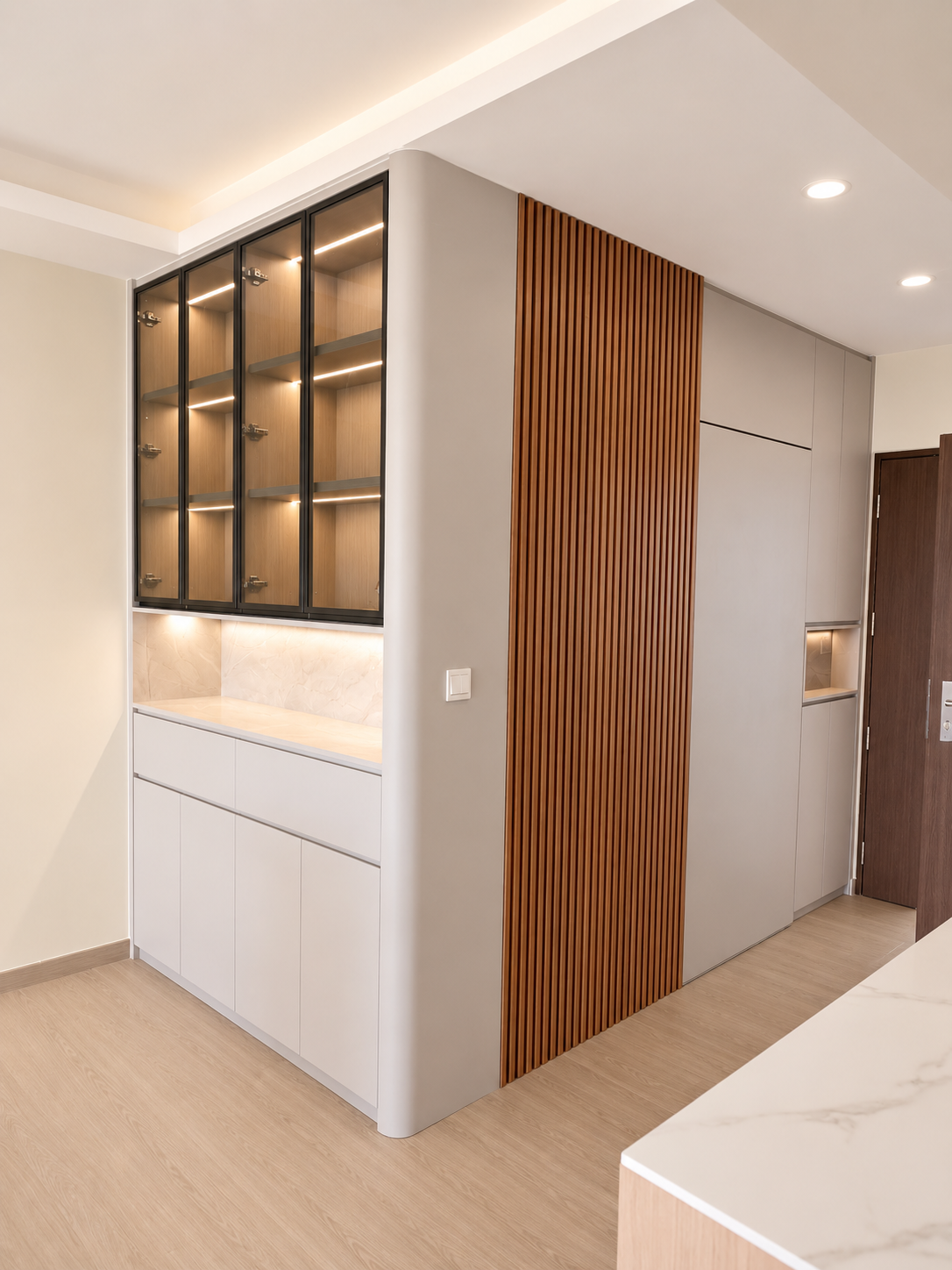
On a large feature installation like this 308B Tengah Park display wall, we confirm the grade on the manufacturer’s paperwork, not just in the quote. You can ask for exactly the same for your own project.
Questions to ask your contractor
- What is the emission number, and is it mg/m³ or ppm?
- Which standard is that number tested to?
- Can you show the manufacturer’s test report or the panel label?
- Are the doors and laminate tested to the same grade as the carcass?
The grade is the label. The test method behind it is what the label means.
Frequently asked questions
Is a lower number always better? For indoor air, yes, a lower emission figure means less formaldehyde released. Just make sure you are comparing numbers tested to the same standard.
Do I need to see a test report for a small job? For a single small cabinet, the grade in the quotation is usually enough. For a full-flat fit-out, it is reasonable to ask to see the manufacturer’s documentation.
My quote just says “E0 board”. Is that enough? It is a start, but ask which standard it is tested to and whether the doors match. “E0” with a named standard, in writing, is what you want.
Renovate together and save
Specifying a verified low-emission grade costs less than most homeowners expect, and less again through group renovation. With BTO Group Reno, neighbours in the same project share prefabrication and installation, so you can hold out for a properly tested E0 or ENF spec without placing unnecessary pressure on the budget.
Explore more
- Start here: E0, E1 and ENF — what the formaldehyde grades mean
- Next: How to actually get low-formaldehyde carpentry (not just a label)
- See our full portfolio of completed HDB homes
Ready to start your renovation?
Every kitchen and wardrobe you have seen here was designed, prefabricated in our own local workshop and installed by our own team — backed by 1,000+ HDB projects across Singapore. So the board grade we promise is the board grade you get.
- Book a free showroom visit to see and compare board finishes in person.
- Join a Group Reno for your BTO, or check the upcoming groups.
- Prefer to talk? Contact us or call +65 8852 6257.
Related HDB Carpentry Guide: For a broader overview of cabinet materials, design and fabrication considerations, see our HDB BTO carpentry guide.
