
HDB Kitchen Cabinet Water Damage: Why the Sink Unit Fails First
The cabinet under the sink is the one box in an HDB flat that sits warm, closed and damp for a decade while carrying the heaviest thing in the kitchen. What is happening in there, how to tell how far along yours is, and the four build details that change it.
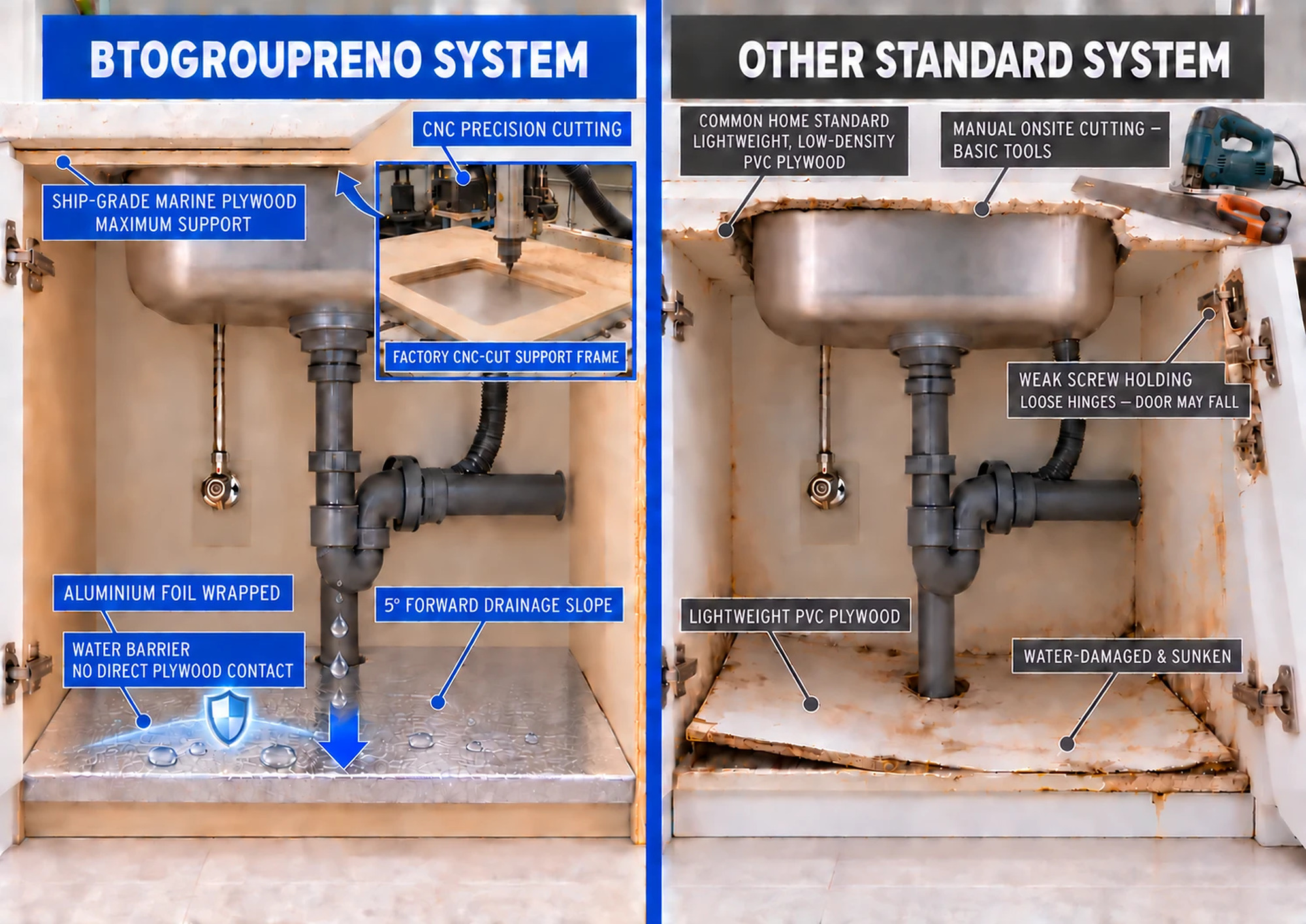
Walk through a five-year-old HDB kitchen and the cabinet that has given up is almost never the one you look at. The wall cabinets are fine. The drawer bank is fine. The door under the sink closes with a soft knock that it never used to make, and when you open it the base has a dark tide line across the back and a dip you can feel with your palm.
That cabinet did not fail because the carpentry was cheap. It failed because it is the one box in the flat that is asked to sit in a warm, closed, damp space for a decade while carrying the heaviest single object in the kitchen. Almost nothing else in the flat has that job.
Kitchen cabinet water damage in a Singapore flat almost always starts in that one box. This is what is actually happening in there, how to tell how far along yours is, and the four build details that decide whether the base is still flat in year five.
Why this one cabinet and not the others
Three separate stresses stack up in the same 600 mm wide box, and they reinforce each other.
It never gets to dry outA closed cabinet around cold pipes in a tropical kitchen sits at a higher humidity than the room it is in. Condensation forms on the trap, runs down and sits on the base board. Nothing moves the air through.
Humidity
The leaks are slow, not dramaticA weeping compression nut or a hairline split in a flexible hose releases a few millilitres a day. It is under the base board before you would ever notice it, and it does not stop.
Slow drip
It carries the heaviest thing in the kitchenA stainless basin full of water and dishes is roughly 25 to 35 kg, held up by the worktop and the cabinet around it. Wet board loses stiffness, and the load then concentrates on whatever is still holding.
Load
The order mattersHumidity softens the board, the slow drip finds the softened edge, and the load turns a soft edge into a visible dip. Fix any one of the three and the other two take much longer to do damage.
Board choice on its own does not settle this, which is why a cabinet made of a perfectly reasonable moisture-resistant board can still sink at the sink. We wrote separately about matching board grade to the zone it sits in; this article is about the four things that happen to the board after it is chosen.
What kitchen cabinet water damage looks like, in order
It is gradual, and each stage has a tell. The timings below are what we see on site rather than a published standard, and a flat with a slow leak runs through them faster. Most owners first notice at stage three, which is two stages too late to fix it cheaply.
Months 6 to 18Nothing visible, something smells
A faint musty note when you open the door, strongest at the back. The board has taken on moisture and has not given it back. This is the cheapest moment to intervene and almost nobody does.
Years 2 to 3The edge lifts
The laminate along the front edge of the base lifts a millimetre or curls at a corner, usually where the edge was cut on site and never sealed. Water now has a direct route into the core.
Years 3 to 5The base dips and the door stops shutting
The swollen core loses stiffness under the basin. The base sags, the carcass racks slightly out of square, and the door that used to close flush now catches. At this point the fix is replacement, not repair.
Nothing in that sequence needs a burst pipe. It is the ordinary condition of a Singapore kitchen doing its job.
The four details that change the outcome
These are the four we build into every sink cabinet that leaves our factory. Each one interrupts a different part of the sequence above, and none of them is visible once the cabinet is installed — which is exactly why they are easy to leave out.
| Humidity | Slow drip | Load | What it does | |
|---|---|---|---|---|
| Ship-grade marine plywood base | ✓ Interrupts it | ✓ Interrupts it | ✓ Interrupts it | A dense cross-laminated core with a water-resistant bond. It keeps its stiffness after repeated wetting instead of softening and staying soft. |
| Factory CNC-cut support frame | ✗ Does not address it | ✗ Does not address it | ✓ Interrupts it | The opening is cut to the exact basin model and a frame takes the weight, so the load never depends on screws in a panel that is getting damp. |
| Aluminium foil wrapped base | ✓ Interrupts it | ✓ Interrupts it | ✗ Does not address it | A continuous barrier between water and plywood. Neither the condensation nor the drip reaches the core at all. |
| 5° forward drainage slope | – Helps indirectly | ✓ Interrupts it | ✗ Does not address it | Water leaves at the front edge instead of pooling at the back, so a slow leak shows itself in week one rather than year three. |
✓ Interrupts it – Helps indirectly ✗ Does not address it
Read it across, not downNo single detail covers all three stressors, which is why leaving one out matters. The frame is the only thing handling the load; the foil is the only thing handling standing water; the slope is the only thing that makes a leak visible.
These four are our factory standard, not an upgrade lineEvery sink cabinet we build leaves with all four. The cut-away above and the rest of the build are on the Craftsmanship tab of our company profile.
If you want the longer version of how we build it, it is item 03 on the Craftsmanship tab, and the kitchen system page covers the worktop and kerb that sit above it.
A five-minute check on the cabinet you already have
Do this with a torch and a dry tissue. It works whether your flat is one year old or eight.
5 checks
Signs you are fine
- The base sounds solid when you tap it, front and back
- The front edge laminate is flat and tight along its whole length
- A tissue pressed into the back corners comes up dry
- No musty smell when the door has been shut for a day
- The door still closes flush without catching
5 warnings
Signs to act on now
- A dark line or stain across the base, especially at the back
- The laminate edge lifts or feels spongy under a thumbnail
- Any give under your hand when you press the base near the trap
- Green or black spotting on the underside of the worktop
- A door that has started to rub in the last few months
Where to pressThe back two corners and the strip directly under the trap. Those are the three places water collects in a flat base, and all three are behind the pipework where you never look.
If it has already swollen
Be honest about which problem you have. A stain with a solid base underneath is a moisture problem: find and stop the source, dry the cabinet out with the door open and a fan for a few days, then seal the cut edges. Swelling you can feel is a board problem, and board that has swollen does not go back. Filler and a new laminate strip will hide it for a season and it will come back, because the core is already delaminating.
The cheap version of the repair is replacing the base board and the edge treatment while the carcass sides are still sound. The expensive version is waiting until the sides have gone too. There is a practical walk-through in our long-term carpentry maintenance guide, and if your flat is still inside its defects period, start with the post-installation audit checklist instead.
Frequently asked questions
Is marine plywood really necessary, or is it just an upsell?
For the sink cabinet base and the bathroom vanity base, the extra cost buys you a material that keeps its stiffness after repeated wetting. For a bedroom wardrobe it buys you very little. That is the honest split, and it is why we specify by zone rather than selling one board for the whole flat.
My contractor says the base is “moisture resistant”. Is that enough?
It is a start, and it is not a specification. Moisture-resistant describes the board; it says nothing about whether the cut edges were sealed, whether the basin load goes into a frame, or whether the base can drain. Those are the parts that fail. There is a list of the exact lines to ask for in our wet-zone quotation guide.
Will my warranty cover it if the base swells?
Usually not. Moisture damage is excluded from most carpentry warranties in Singapore, ours included, for the straightforward reason that nobody can tell after the fact whether it came from the build or from a hose that was left dripping. We wrote up what carpentry warranties in Singapore actually cover, with our own terms stated plainly.
How long should a sink cabinet last?
Built with the four details above and with plumbing that is not leaking, the carcass should outlast the worktop. The realistic failure point becomes the hinges and runners, which are replaceable parts.
The short version
The cabinet under your sink is the hardest-working box in the flat and the one nobody specifies carefully. Four details — a marine plywood base, a factory-cut support frame, a foil wrap and a forward slope — are what separate a base that is flat in year five from one that is not. None of them is visible at handover, and all of them are decided before the panel is cut.
If you are still at quotation stage, the five lines to put into your carpentry quote will get you a straight answer from any contractor. If you are past that, the five-minute check above tells you where you stand.
