
Kitchen Cabinet Quotation in Singapore: Five Lines for the Wet Zones
“Moisture resistant” names the board and says nothing about the edges, the support, the barrier or the drainage. Five short lines to add to a carpentry quotation, what a fair push-back sounds like, and what it is reasonable to pay.
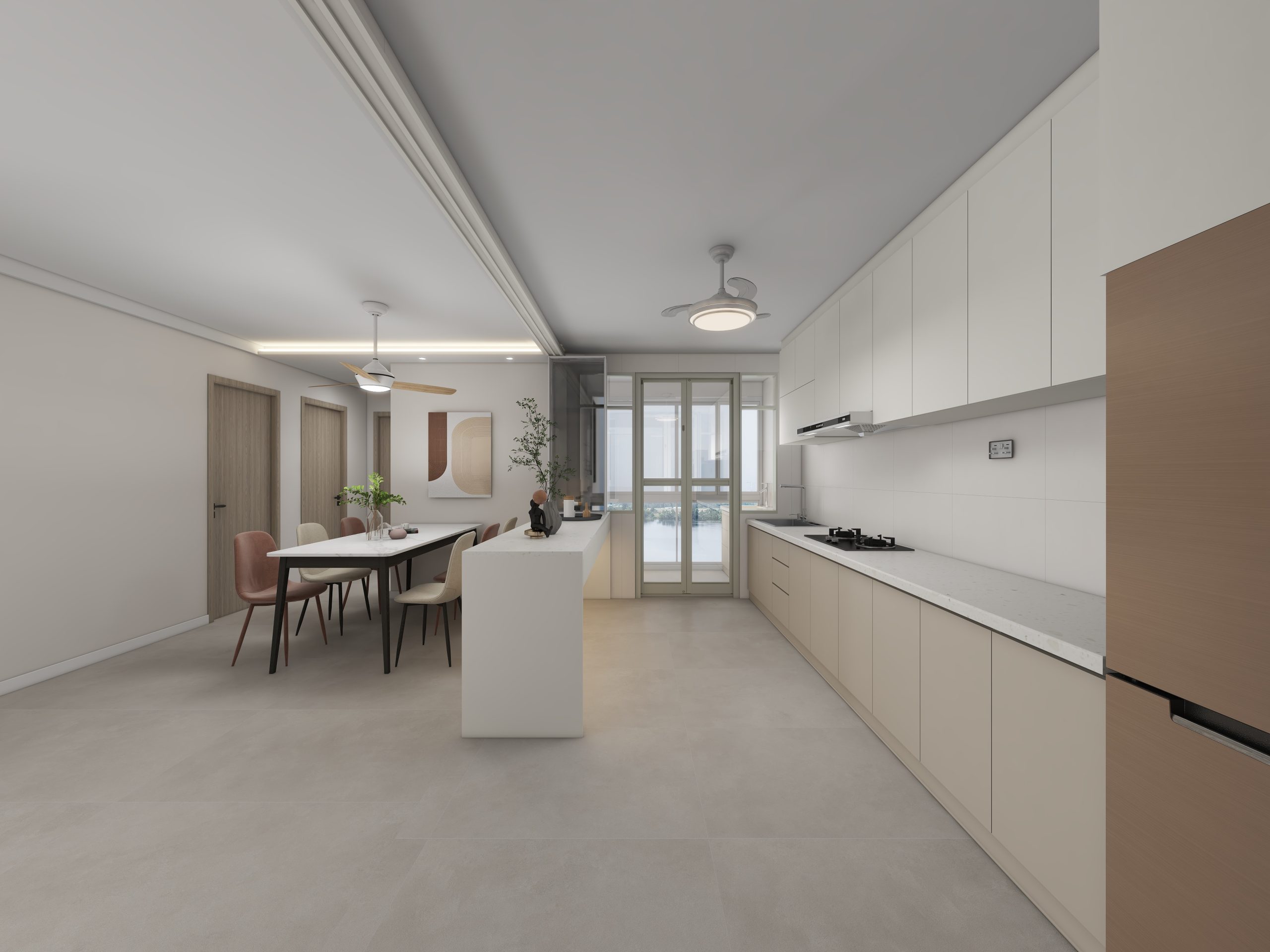
Nearly every kitchen cabinet quotation in Singapore describes the wet areas in two words: moisture resistant. It reads like a specification. It is not one. It names the board and says nothing about the four things that actually decide whether a sink cabinet is still flat in year five — the edges, the support, the barrier and the drainage.
These are five lines you can add to a quotation before you sign. They are short, they are checkable at installation, and a contractor who builds this way will not object to any of them. If you want the reasoning first, it is in why kitchen cabinets fail under the sink first.
Why a one-word spec fails on a kitchen cabinet quotation
“Moisture resistant” covers a genuinely wide range of products, and even the good end of that range fails if the cut edge at the plumbing cutout is left raw. The board is one of five variables and it is the only one that usually gets written down. The other four are decided quietly on site, by whoever is holding the jigsaw that morning.
The test for whether something is a specificationCould a third party turn up at installation and tell you whether it was done? “Moisture resistant” fails that test. “All cut edges at plumbing cutouts sealed” passes it.
The five lines
Write them into the quotation itself, or send them as a message and ask for a written yes. Either way they need to exist somewhere other than a conversation.
Line 1Name the board and the zone
“Sink cabinet base and bathroom vanity base: marine or WBP-bonded plywood.” Specify by zone, not for the whole flat — paying for marine board in a bedroom wardrobe is money that buys nothing.
Line 2Seal every cut edge at the cutouts
“All cut edges at plumbing and waste cutouts to be sealed.” The cutout is made on site after the panel leaves the factory, and a raw edge there is the single most common entry point.
Line 3Support the basin on a frame
“Basin to be carried on a support frame cut to the basin model, not on screws through the carcass panel.” A full basin is 25 to 35 kg, and screw holding is only as strong as the board around it.
Line 4Put a barrier under the base
“Sink cabinet base to be wrapped with a continuous water barrier.” Foil, tray or sheet — the requirement is that standing water never reaches plywood, not the brand of the material.
Line 5Make the base drain forward
“Sink cabinet base to fall forward so any water drains to the front edge.” A flat base hides a leak until the damage is done; a sloped one shows you the first time you open the door.
Five lines, one paragraphYou can paste all five into a message in under a minute. The answers you get back will tell you more about a contractor than any showroom visit.
Three wet zones, not one
The kitchen sink cabinet gets all the attention and it is not the only box in the flat living in water. Apply the same five lines to all three and the cost difference across a whole flat stays small, because these are three cabinets and not thirty.
Highest risk
Kitchen sink cabinet
- Enclosed, warm, and around cold pipes all day
- Carries the heaviest single load in the kitchen
- Two or three cut edges at the trap and the waste
- Almost never specified beyond the board name
Second highest
Bathroom vanity
- Constant airborne humidity even with no leak
- Cut edges at the basin waste and the tap feed
- Often the last cabinet anyone inspects
- Frequently given the same board as a bedroom unit
Underrated
Service yard base units
- Mopped floors and a washer that occasionally overflows
- Least ventilated cabinets in most HDB flats
- Usually quoted as ordinary base cabinets
What it is reasonable to pay for
Let me be direct about cost, because the five lines are not free and you should know roughly what you are asking for. Upgrading a carcass from a standard board to a moisture-resistant or marine-grade one is commonly quoted in Singapore at somewhere around ten to twenty per cent over the standard board price for the run it applies to. Applied to three cabinets rather than the whole flat, that is a small number against the cost of replacing a sink cabinet in year five.
The other four lines are mostly labour and method rather than material. Sealing a cut edge costs minutes. A support frame costs a factory cut that a CNC machine is making anyway. A foil wrap and a slope cost almost nothing at build time and cannot be added afterwards at any price. That asymmetry is the whole argument: these are decisions, not upgrades, and they are only available before the panel is cut.
On our own quotations these five are already in the buildWe build every sink cabinet with a marine plywood base, a factory CNC-cut support frame, a foil wrapped base and a 5 degree drainage slope as standard. The cut-away is item 03 on the Craftsmanship tab.
If the contractor says no
Some of these will get a reasonable push-back and some will not, and it is worth telling them apart.
“We already do that, it is just not written down”The normal answer from a firm that builds this way. Ask for it in writing anyway. It costs them nothing and it gives you something to point at.
Fair
“The slope is not standard practice here”True — it is not universal. It is also cheap and it only exists if someone decides to do it. Treat it as the optional one of the five if you need to trade something away.
Negotiable
“Sealing every cut edge will delay the job”Sealing a handful of cutouts is minutes of work. If this is the objection, the real issue is that the cutouts are being made on site by someone in a hurry.
Push back
“That is a premium upgrade” — for all five linesBoard grade is legitimately a cost line. Edge sealing, a support frame, a barrier and a slope are method, not material. Ask which of the five the premium is actually for.
Itemise it
How a contractor answers these is also a reasonable read on the firm generally. If you are still choosing, what homeowners miss when picking a carpentry sub-contractor covers the rest of it, and site measurement before manufacturing explains why the cutouts should not be a site improvisation in the first place.
Frequently asked questions
Will adding these lines make my quotation more expensive?
The board line might, by roughly ten to twenty per cent on the runs it applies to. The other four are method rather than material and should not move the price much. If all five come back as one large premium, ask for it itemised.
Can I add these after the carpentry is installed?
Edge sealing, partly. The support frame, the barrier and the slope, no — they are built into the panel before it is assembled. That is the reason to raise them at quotation stage rather than at handover.
Is this overkill for a new BTO flat?
A new flat has new plumbing, which removes the leak risk for a while and does nothing about ambient humidity. The failure sequence still runs, just more slowly. These five lines are cheapest on a new flat because nothing has to be undone.
What if I am buying an off-the-shelf or modular kitchen?
Ask the same questions of the supplier. Modular systems vary widely at the sink module specifically, and the answer about how the basin is supported is the most revealing of the five.
The short version
Board grade is one of five variables and the only one anybody writes down. Name the board by zone, seal the cut edges, carry the basin on a frame, put a barrier under the base and make it drain forward. Five lines, one message, and they are only available before the panel is cut.
What you are protecting against is set out in why kitchen cabinets fail under the sink first, and why the warranty will not do it for you is in what a carpentry warranty actually covers. If you would rather not manage any of this yourself, it is already how we build — see the built-in cabinet range.
